I build AI systems for what’s next.
I’m a fresh AI Engineering graduate exploring Voice AI, from conversational agents and real-world evaluations to AI agent infrastructure and products for blue-collar workers. I’m especially interested in what’s next: **S2S models, real-time voice, RL-finetuned ASR, and better Voice AI evaluation.** Early in my journey, but always building, learning, and looking ahead.

It started in my second year with a group project on Explainable AI. Using LIME, I became curious about what happens inside black box models and why they make certain decisions. That curiosity pulled me deeper into AI and eventually into robotics, where I worked on an autonomous agricultural robot through the e Yantra Robotics Competition.
Later, at Dialflo, I got the chance to build Kannada voice agents for ITI candidates and vendors. Working with real users made me notice the gaps in Voice AI and led me to build a system for evaluating conversations and finding those failures. I also explored building a professional network for blue collar workers.
At QuickCall, I got deeper into the engineering side of AI through agent infrastructure, telemetry and sandboxing. Now I’m exploring S2S voice models, real time voice, better ASR and AI evaluation. I’m still early in my journey, but I learn best by building, finding gaps and trying to solve them.
Dialflo.ai
Built a Kannada voice agent that asks callers structured questions and collects their information, then developed English and Hindi conversational agents on the Dialflo platform. Audited production calls to trace where responses and flows broke, and wrote the preprocessing and prompt-generation scripts that made each next version less wrong.
QuickCall.dev
Designed the telemetry pipeline — every message, tool call, token and error captured as JSONL, queued in SQLite with WAL mode, synced to Postgres. Built the Docker harness giving every candidate an identical sandbox, packaged the agent as Bun-compiled single executables for macOS, Linux and Windows, and contributed shared agent logic to the npm monorepo.
KLE Technological University
Machine learning, deep learning, NLP, speech processing, and robotics on paper. In practice: Python, C++, and plenty of evenings spent wiring LiveKit, pipecat into things that actually talk back.
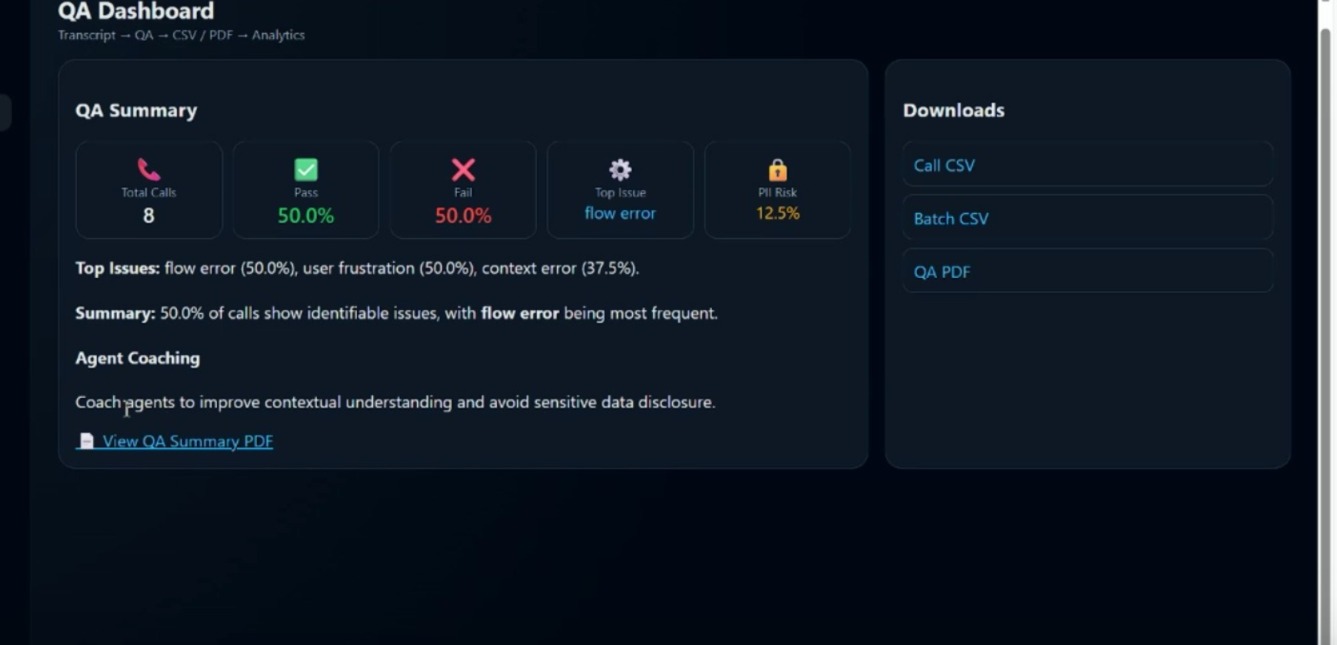
Voice Call Audit Assistant
DEMO ↗Auditing voice calls typically means manually listening through hours of recordings slow and hard to scale. Inspired by EkStep Foundation's voice AI testing framework, I built a proof-of-concept system that analyzes call transcripts, flags potential issues, and surfaces agent recommendations cutting manual review time for auditors.
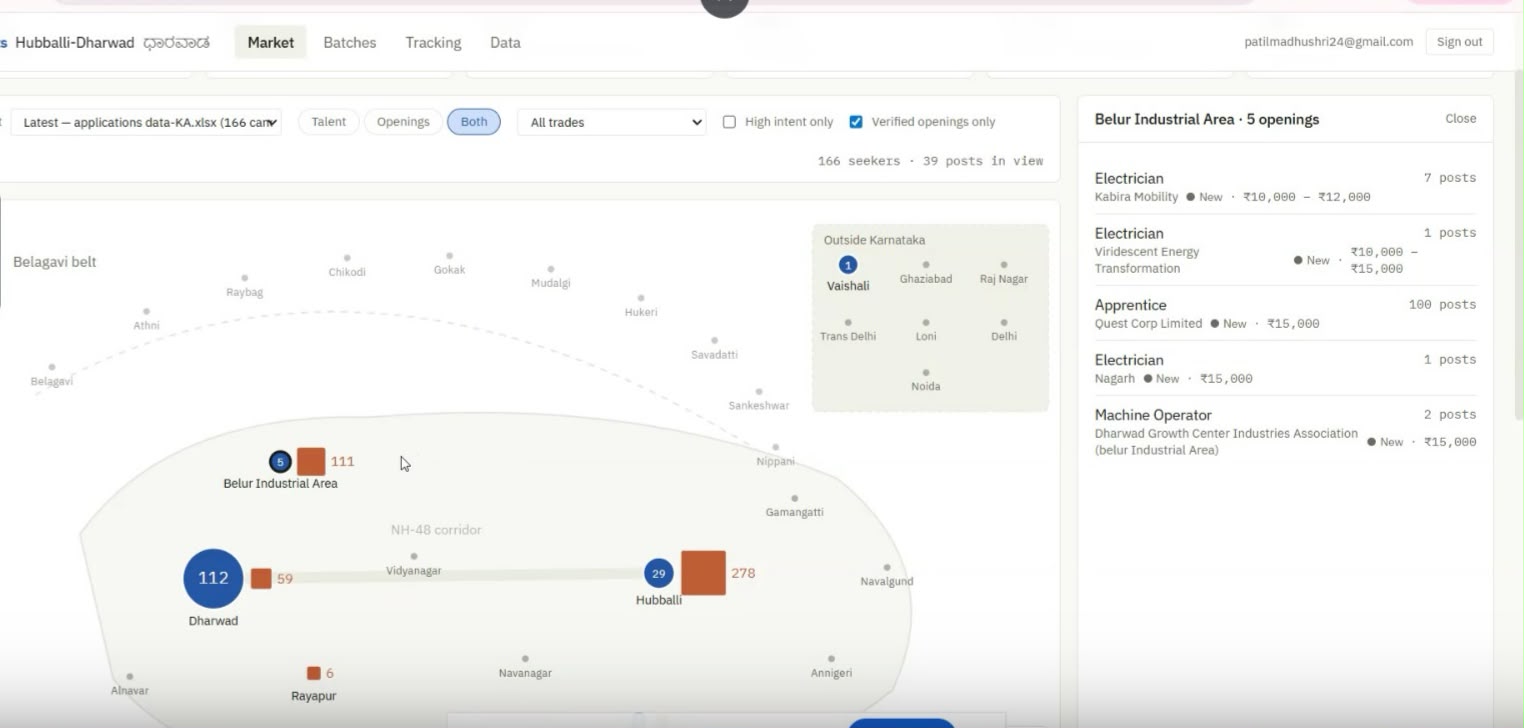
Talent Compass — Recruiter Workspace for Blue-Collar Hiring
DEMO ↗Every morning, staffing teams face thousands of messy job listings and seeker profiles. Talent Compass turns that chaos into action cleaning data, mapping locations, matching candidates to vendors, and ranking the best fits in seconds. One click sends the shortlist to WhatsApp, while the calendar tracks follow-ups until someone gets hired. No spreadsheet juggling. No manual matching. Just upload, see, send, track
Vapi for S2S — Real-Time Voice Orchestration Platform
Most voice AI platforms like Vapi are built around traditional STT→LLM→TTS pipelines. S2S models skip that pipeline entirely but lose the hooks those platforms use for call transport, safety filtering, and state management along the way. This project rebuilds that orchestration layer natively for S2S: WebRTC streaming, real-time guardrails, call routing, and a monitoring dashboard for production voice agents.
RL-Finetuned ASR for Real-Time Voice Agents
Standard ASR models are trained for offline transcription accuracy, not the tradeoffs real-time voice agents need low latency, robustness to interruptions and noisy audio, and fast partial transcripts. This project fine-tunes an ASR model with reinforcement learning, optimizing directly for these production-relevant signals rather than word-error-rate alone
Voice AI Evals Upload, Test, and Score ASR, TTS & LLM
Upload audio or voice samples , run them across multiple ASR, TTS, and LLM models, and get scored results back so you can see which one actually performs best before you build on top of it.
My Thoughts on AI and the Future I’ve been thinking about what kind of new jobs and roles will exist in the next 10 years, especially seeing how fast AI, coding, and companies are changing. I also wonder if there is an AI bubble, considering companies are spending billions on cloud infrastructure and data centres. At the same time, the amount of electricity and water these data centres need makes me question whether this growth is actually sustainable. Maybe the AI bubble could burst, but even if it does, I feel like the way we work and the kinds of jobs we have will change completely.
I decompress with an embarrassing number of Subway Surfers runs — the only game I am objectively improving at.