OVERVIEW
Recent advancements have improved Automatic Speech Recognition (ASR) for Indian languages and mixed English Hindi speech. However, code switching and background noise present significant challenges, with ASR systems experiencing a 30–50% higher Word Error Rate (WER) on code-switched speech compared to monolingual speech.
Here in this blog, there will be a comparison table, and top recommendations are provided for integrating a production-ready voice-AI agent in India that must handle Hinglish inputs.
Thanks for reading Madhushri’s Substack! Subscribe for free to receive new posts and support my work.
Why Choosing the Right ASR Is Still Difficult?
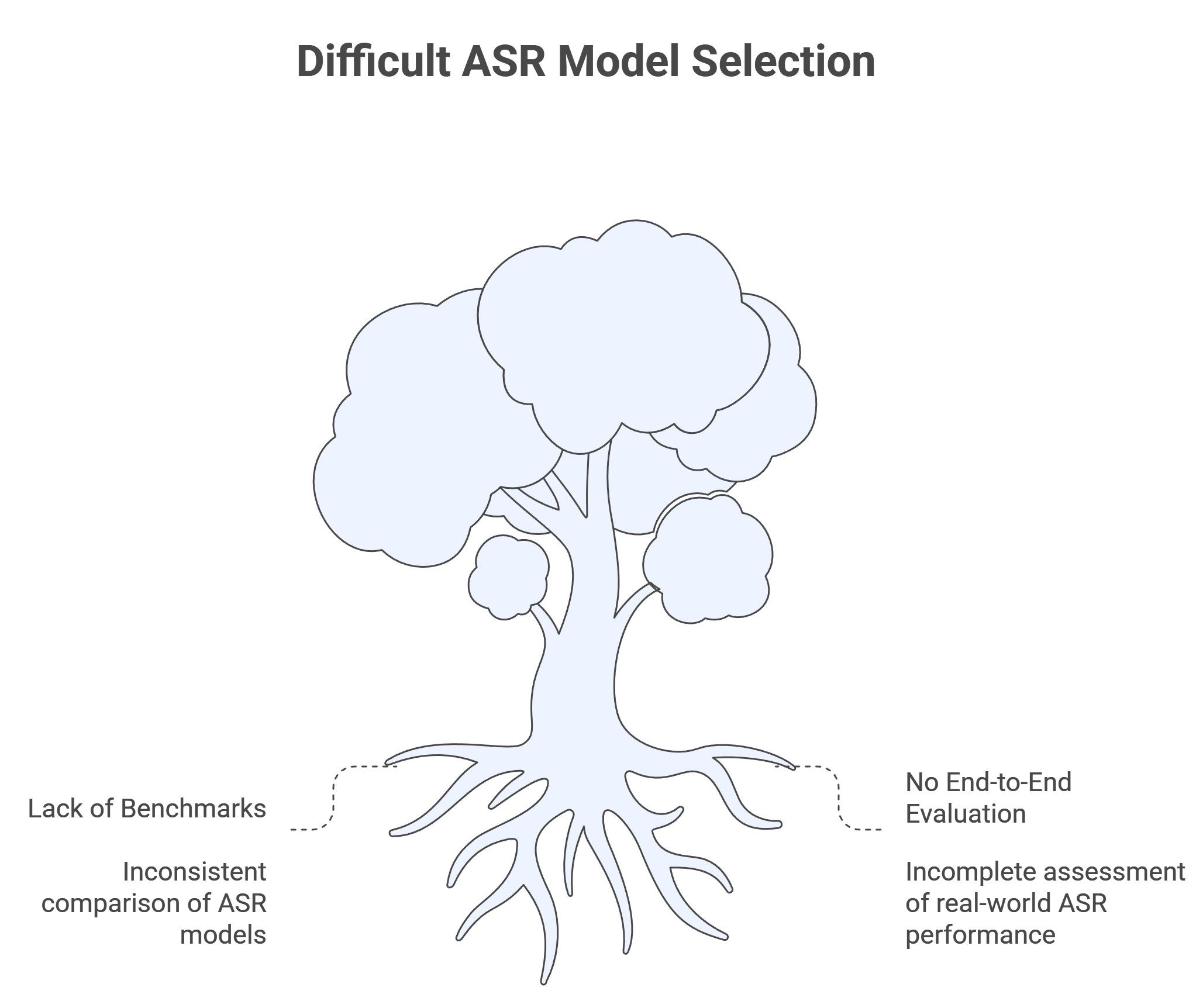
ASR models are evolving rapidly, but there is currently no proper benchmark to evaluate which ASR model is most suitable for specific use cases, especially for voice AI agents. Additionally, there is no end-to-end pipeline in place to facilitate this evaluation. This actually makes the thing difficult to choose which ASR model, as there is no consistent way to compare WER on code-switched speech, real-time latency, accent robustness, background-noise performance, or domain-specific vocabulary handling across different models.
Open‑Source ASR Engines Supporting Indian Languages
Open‑source models offer flexibility, privacy, and cost efficiency, but their performance especially on Hinglish varies widely.
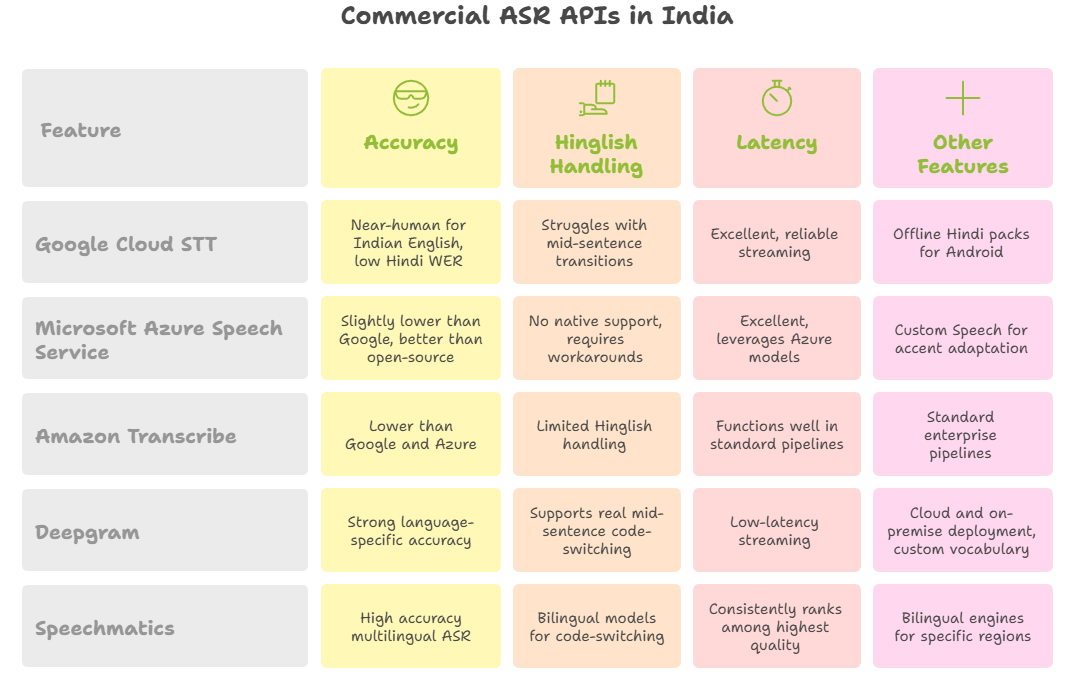
OpenAI Whisper is one of the most popular multilingual models and supports over 100 languages, including Hindi and Indian‑accented English. Its Large‑v2/v3 versions are known to handle code‑switching reasonably well and are trained on an enormous 680k‑hour dataset. Whisper often delivers strong baseline accuracy but can still lag behind closed‑source systems like Google and Azure by more than 10% absolute WER in Hindi benchmarks. However, fine‑tuning changes everything: models tuned on ~2,500 hours of Hindi have achieved WER in the low teens, making Whisper competitive with enterprise ASR engines. Real‑time performance depends heavily on model size Large requires GPU streaming, while Medium/Small can run near real‑time on modern CPUs with minor accuracy trade-offs. Whisper’s biggest advantage remains its open-source nature, enabling on‑premise deployment and deep customization without API fees.
Wav2Vec 2.0 / XLS‑R models from Meta form the backbone of many Indic ASR projects. Out of the box, MMS/XLS‑R performs decently on Indian languages but still trails commercial systems. The strongest results come from EkStep’s Vakyansh initiative, which trained wav2vec models on over 10,000 hours of Indian speech. These models achieve 10 - 15% WER in clean Hindi but are primarily monolingual, meaning they struggle with Hinglish. Hinglish‑tuned variants perform significantly better around 21.8% WER, compared to 28 30% for non‑adapted models. Overall, wav2vec‑based models are reliable choices for pure Hindi or pure English tasks, on‑prem deployments, or scenarios requiring local processing, but they need extra bilingual training to succeed in Hinglish environments.
Vosk/Kaldi, one of the classic offline ASR engines, is designed for low-resource devices. Its Hindi model is just 40 MB and can run smoothly on mobile CPUs. But the trade-off is accuracy: conversational Hindi typically sees 20 30% WER, and Vosk does not inherently support mid‑sentence code-switching. It is ideal when extreme deployment flexibility is needed offline usage, no GPU, or on‑device processing but not for high-accuracy Hinglish transcription.
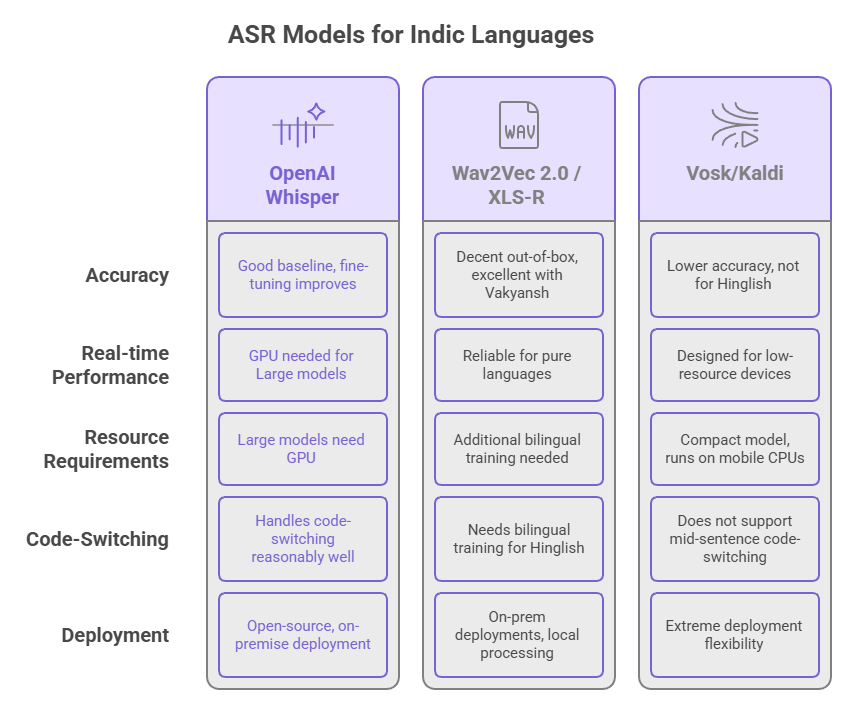
Commercial ASR APIs Used in India
Commercial ASR services are far more accurate, stable, and optimized for real-time applications but come with cloud fees and less control over data unless on‑prem options are available.
Google Cloud Speech‑to‑Text (STT) remains one of the top-performing engines for Hindi and Indian English. Google’s 2023 v2 model achieved near-human accuracy for Indian English and consistently outperforms open-source models on Hindi WER. However, while Google supports language detection, it still does not handle natural Hinglish mid‑sentence transitions well English words inside Hindi sentences may be misinterpreted. Latency is excellent, streaming is reliable, and Android offers offline Hindi packs for mobile deployment. In most benchmarks, Google provides the lowest Hindi WER among all commercial engines.
Microsoft Azure Speech Service is another strong option, delivering accuracy only slightly lower than Google but significantly better than most open models. Azure still doesn’t support true mid-sentence Hinglish; instead, workarounds like dual transcriptions or auto-detection are used. It does offer Custom Speech, which helps with accents and domain vocabulary but doesn’t completely solve code-switching. Latency is excellent since Azure’s models power products like Teams and Cortana.
Amazon Transcribe supports Hindi and Indian English but generally lags behind Google and Azure in raw accuracy. Hinglish handling is also limited. It works well in standard enterprise pipelines but is not usually the first choice when high accuracy for Indian ASR is required.
Deepgram stands out because it actually supports real mid-sentence Hinglish code-switching without any hacks. Their Nova models, especially Nova‑3, demonstrate ~10.9% WER on code‑switched audio, beating multiple open‑source baselines. Hindi WER (~23%) and English WER (~2%) also show strong language-specific accuracy. Deepgram offers low-latency streaming, cloud + on‑prem deployment, custom vocabulary, and competitive pricing under $1 per hour at scale. For real-time Hinglish use cases, Deepgram is one of the best balanced options.
Speechmatics has built a reputation for extremely accurate multilingual ASR and recently introduced bilingual models for regions with heavy code-switching. Their Tamil‑English and Malay‑English bilingual engines showed 15% better code‑switching accuracy compared to competitors. Although their Hinglish-specific benchmarks are not yet published widely, Speechmatics consistently ranks among the highest-quality ASR providers globally.
Benchmarks and Performance Summary
Based on public papers, third‑party tests, and community benchmarks, the approximate performance landscape for Hinglish and Hindi ASR looks like this
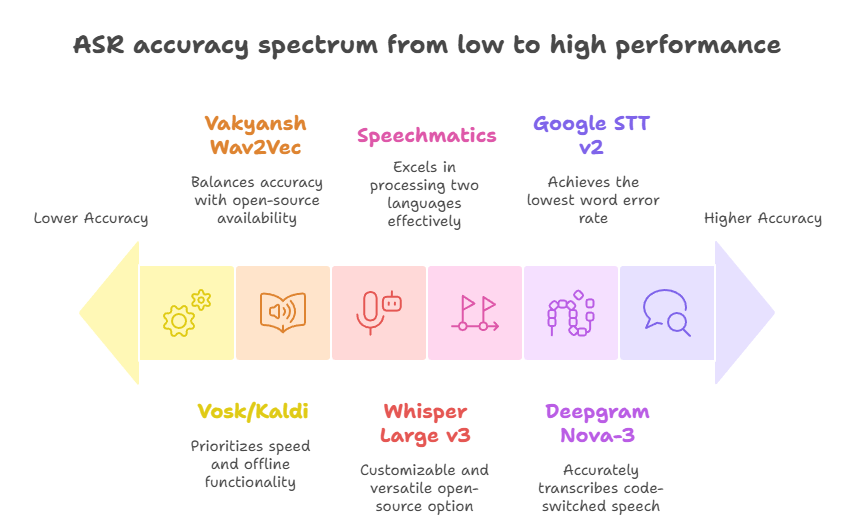
Best Hindi Accuracy (lowest WER): Google STT v2
Best Hinglish Code‑Switching Accuracy: Deepgram Nova‑3 (~10.9% WER)
Best Open‑Source Model for Hinglish: Whisper Large v3 (improves further with fine‑tuning)
Best Hindi Open‑Source Accuracy: Vakyansh Wav2Vec models (10 %-15% WER in clean audio)
Best for On‑Device / Offline: Vosk/Kaldi (but lower accuracy)
Best Bilingual Architecture: Speechmatics bilingual engines
Overall, the ASR ecosystem for Indian languages is improving rapidly, but Hinglish remains a difficult challenge that only a few systems mainly Deepgram, Whisper (with tuning), and Speechmatics handle effectively in real conversational settings